98 Fremont Place

WESTMORELAND PLACE
FOR AN INTRODUCTION TO FREMONT PLACE, CLICK HERE


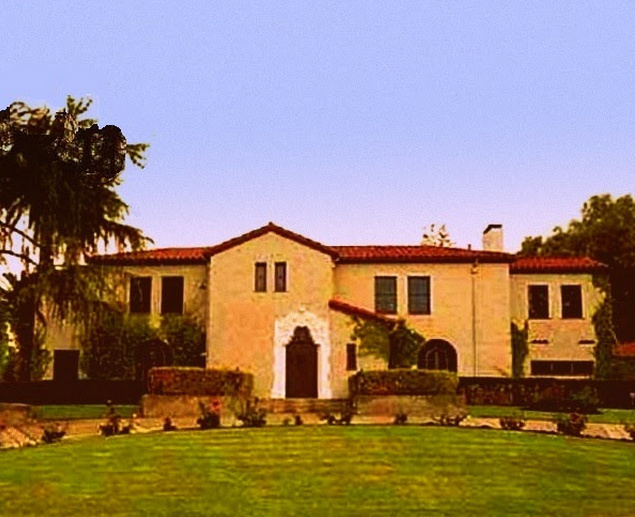
Some houses are fickle; put another way, while some houses attract loyal owners who stay for decades, others, for no particular reason, appear to have been built with revolving front doors. A case in point is the large Mediterranean number at the northeast corner of Fremont Place West and Eighth Street. A dentist with social and sporting ambitions as well as, apparently, means beyond what one could pull down by pulling teeth in 1919, Dr. William S. T. Smith had only just arrived permanently in Los Angeles from Kansas City. Born in Connecticut in 1872, Smith moved to Missouri in the '90s after college to prepare for his profession; after marrying a local woman in 1901—perhaps it was she who possessed capital beyond that of the typical young dentist—the couple moved to one of the nicer new south Kansas City suburbs where they acquired a large house on Washington Street in a tract developed by the old-guard McGees, as well as a live-in chauffeur and maid. Two children and some investigatory trips to California later, Smith sniffed out Fremont Place as well as a favored architect of other builders in the five-year-old tract, which was just beginning to take off. The firm of Meyer & Holler designed "an attractive residence of Spanish design," the Times reported on December 14, 1919; the Smiths were renting a house on South Manhattan Place while Meyer & Holler's construction arm, the Milwaukee Building Company, once the Department of Buildings issued its permit on January 10, 1920, completed the project. Initially addressed 41 Fremont Place for its lot number, the house was soon renumbered as 98.

While Dr. Smith does not appear to have opened a practice after settling in Los Angeles, he was keeping his eye on the ball—a small wooden one that literally whistled through the air as riders on horseback whacked it with long mallets. Perhaps, at 48, having discovered the glamour of polo, the dentist had retired. Within just a few years, he had also discovered Bel-Air, the luxurious west-side development that opened only a few years after Smith moved into his new house in Fremont Place. Bel-Air and its space and promotion of "in-town estates" revealed that behind its grand gates, Fremont Place was just another middle-class subdivision, if a lovely one...anyway, no room for horses or chukkas there. By 1924, Dr. Smith was building another big new house and preparing to sell #98.


A 2015 view of the 95-year-old 98 Fremont Place does not reveal the large office building,
 built in 1986 on what were originally Fremont Place lots facing Wilshire Boulevard, on
 the other side of its tennis court; a coat of vegetation softens stark stucco walls.
 

On March 8, 1924, the Los Angeles Evening Express reported that Dr. Smith the polo player had just sold his Fremont Place house to Kalamazoo paper-company executive Herbert E. Floercky, whose stay was also brief. Floercky moved to Beverly Hills in 1927. That year, advertisements for the sale of the house ran in the papers describing a "gorgeous Italian home"—we are now Italian rather than Spanish—that "must be sold as the owner has moved away." A price is not mentioned, but there seem to have been no takers. Offered for sale around the same time was 121 Fremont Place, which also appears to have languished on the market despite being described as priced for quick sale; the owner of that house appears to have accepted renters pending a sale, as would Floercky (or whomever 98 may have been sold to) soon enough. Interestingly, numbers 98 and 121 would come to share a common tenant, which is not to say a common gangster.


Rented by at least five families from the '20s into the '50s, the actual owner of the house during these
decades remains obscure; the original owner, dentist W. S. T. Smith, who left for Bel-Air after less
than five years, sold it to paper-company executive Herbert Floercky in 1924. Floercky put 98

on the market three years later but may have been forced to retain it as late as the kit-
and-kaboodle auction advertised in the Times on March 5, 1929, or even longer.
Its next renters (and definitely most notorious tenants) would be Mr. and
Mrs. Guy McAfee. He was leading a double life as the head of the
LAPD's vice squad yet tolerated by the department as a
gambling promoter; Mrs. McAfee was a madam.


One way for the crooked head of the LAPD vice squad to maintain a respectable front would have been to live in the middle of clean and haughty Fremont Place. Always more self-conscious of its image than Windsor Square or Hancock Park across Wilshire Boulevard, the Place's gates were meant to draw attention, suggest protection, and to offer status and a challenge to entrance. All of this probably appealed to Guy McAfee. While playing both sides of the law by operating highly remunerative gambling houses—and while his wife Marie worked as a "high-profile Hollywood madam," according Las Vegas historian Byron Craft (Las Vegas being where McAfee would later make his real mark)—he rented 121 for a couple of years. Once that house sold, or its owner got wise to the idea that gangsters in residence may not help unload the house, McAfee simply moved up the street to rent 98. It is unclear as to whether Herbert Floercky actually still owned the house, but, at any rate, a prominently advertised auction of it and its entire contents was held on March 5, 1929. The identity of the winner of the prize is not found in newspaper reports. Perhaps "friends" of McAfee—his syndicate—wound up with the actual title; records indicate that rather than being the nominal owner of 98, McAfee was renting it by April 1930. It is hard to imagine that rumors of McAfee's "gonnections" weren't rampant; apparently his new neighbors were as tolerant of grand-scale crooks as they were once of Hollywood actors such as Mary Pickford and Mary Miles Minter. With many affluent Angeleno happily gambling at reversible tables (in case of a raid) at McAfee's Clover Club on the Sunset Strip, how could there not be rumor as well as tolerance? According to Craft, McAfee had become "a power player in the LAPD’s purity squad, which took aim at a trio of local offenses: alcohol, gambling and prostitution...[he] cleaned up. He accepted bribes from illegal business owners and...operated busy and lucrative gambling houses. His connections with mobsters and his position on the police force proved invaluable, making him privy to inside information that enabled him to stay one step ahead of raids." The McAfees, thug and madam, must have presented well.


Guy McAfee's Clover Club was at 8477 Sunset Boulevard, a world away from the propriety of
Fremont Place (or so most of residents would like to have believed). Never really Fremont
Place material, once reform came to City Hall later in the '30s, McAfee high-tailed it to
 Las Vegas to begin his second act in a town tailor-made for his promotional genius.
While the neighborhood made for a good front, the usual Iowa-bred denizen of
Fremont Place would no doubt have bored him. Too few gamblers there.


Though she was just 38, Marie McAfee had been suffering from high blood pressure for some time when she fell ill at 98 on the evening of May 9, 1932, and died that evening at the Georgia Street Receiving Hospital. Guy would not retain 98 for long; with the winds of reform coming, he would within a few years be on to his second act, which was not behind the bars of San Quentin but as the man credited with creating the Las Vegas Strip—a term he no doubt lifted from a certain notorious few blocks of Sunset Boulevard. Judge Fletcher Bowron's 1938 mayoral campaign promise to clean up Los Angeles's underworld had gotten him into office, where he would remain for 15 years. The new mayor was as good as his word; McAfee got the message and fled. Los Angeles's unlamented loss was Las Vegas's spectacular if no less crooked gain.

With all occupants subsequent to Herbert Floercky appearing to have been renters, the actual ownership of 98 Fremont Place into the 1940s is uncertain. From 1934 to 1938, furniture manufacturer Milton La Verne Gillespie was living in the house along with his wife, Wilma, his parents, Thomas and Lizzie, as well as at least one of his brothers, Forest Haines Gillespie. The clan had originated in Sturgeon Bay, Wisconsin, and come to Los Angeles in dribs and drabs during the 1910s. Both Forest and another of Thomas and Lizzie's sons, Floyd, had been trained as lawyers and were admitted to practice in California in 1916; while Floyd went to work for Henry O'Melveny's white-shoe firm, Forest decided to team up with his father and Milton to manufacture furniture with an eye to the thousands of bungalows being built across Los Angeles that only hinted at the dramatic rise of the city's population, which would well more than double during the '20s. Despite a few personal glitches, the family's success as local industrialists became evident in their acquisition of ever grander addresses over the next decades. Milton's abandonment of a teenage marriage in 1918 and his Fresno child-bride's tabloid-blared demands for money on the basis of an alleged pregnancy were eventually forgotten, as was Forest's having been charged with fraud and grand larceny in 1925 for having, according to the Times, entered into a conspiracy with a school-board purchasing agent "to buy furniture...at prices greatly in excess of those prevailing on the open market," with the two men sharing the extra profit. The jury was deadlocked, apparently freeing Gillespie to, by 1930, plan a big new plant and then sell it to a furniture conglomerate soon after, and then to move to Fremont Place. Not all Gillespies left the neighborhood once the family moved out of 98 in the fall of 1937 and Milton moved to Beverly Hills; Forest, whose first wife, the surgeon Dr. Mary Akey Gillespie, had died in 1932, built 78 Fremont Place for his new wife and children and his parents in 1936. Thomas Gillespie died soon after the move. Still later, in 1955, Forest Gillespie built 206 Rimpau Boulevard in Hancock Park.


George West was one of at least three occupants of 98 Fremont Place during the '40s. Involved in
the early organization of Monogram Pictures, the Poverty Row studio that gave John Wayne
a solid start in Westerns, West was a major distributor for the company in the Midwest.


The next tenants of 98 were yet more renters. (Who owned this house?) Bernard Hartfield and his brothers, Leo and Max, were the proprietors of the Mayson Stores, Broadway purveyors of ladies' wear. Hartfield and his wife and his son and daughter stayed on Fremont Place only briefly. Living in Beverly Hills by the spring of 1942, Bernard Hartfield was dead by March of the next year. Within a few years, Ethel Tardy, wife of lumber company representative Joe Tardy, was hosting dessert bridge parties at 98 given by the Euterpe Opera Reading Club. The Tardys moved out in 1946 to make way for yet another Bekins van coming through the Fremont Place gates to 98 bringing the belongings of longtime film executive George West and his wife, Rose. Mrs. West died in the house on August 18, 1947; her husband, who died 20 years less one day after his wife, was described in his obituaries as a founder of leading Poverty Row studio Monogram Pictures; he later became a producer before returning to the Monogram fold as a franchise holder for the company in various Midwestern cities.

Finally there would arrive at 98 Fremont Place some long-term residents. It is not clear as to just when George West moved out of the house; it is also not known who may have been offering it for sale in the spring of 1950. At any rate, classified ads began to appear that April and May with an asking price of $39,500. Perhaps this was a fair price for an aging house in a style no longer in fashion, one associated with decay that very year in the movie Sunset Boulevard. It seems that 98 may have seen its price further reduced before a wise couple saw its potential as—finally—a long-term home. Psychiatrist and lecturer Edward R. Robbins and his wife Jean along with their son and daughter were in residence by 1952 and would stay for an unprecedented near two decades. After Jean died in April 1970, Dr. Robbins left Fremont Place.
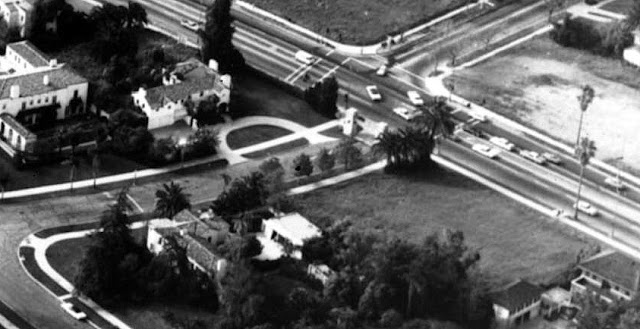

The west Wilshire Boulevard gate of Fremont Place is here near center; Rossmore Avenue runs north
across from it. Number 98 is at lower center-left. In 1968, when this photo was taken, the for-

tunes of Fremont Place (and adjacent subdivisions) was at a low ebb. There was even
serious discussion of wholesale replacement of the neighborhood by business
interests; in the end, once confidence in the residential future of the
district returned, commerce came to occupy only some Wilshire-
facing lots. The one behind 98 and fronting the boulevard
had been empty for decades before it was replaced
with an office building in 1986. The house with
the semicircular driveway  was demolished
and  4472 Wilshire at lower right was
replaced by a condominium.


82 Fremont Place

PLEASE SEE OUR COMPANION HISTORIES
 WILSHIRE BOULEVARD   ADAMS BOULEVARD   WINDSOR SQUARE
   BERKELEY SQUARE   ST. JAMES PARK   WESTMORELAND PLACE  
FOR AN INTRODUCTION TO FREMONT PLACE, CLICK HERE


With the population of Los Angeles in the midst of more than doubling during the 1920s, the Russell Brown Company of Houston—prolific builders of large houses in Texas since 1903—had the audacity to muscle in on a market already well served by at least half a dozen seasoned local architects. It was rare for larger houses in L.A. to be built on spec, but this appears to have been a successful tactic of the firm for two decades; with more than a few lots in Fremont Place still empty, their owners having yet to build or receive offers they couldn't refuse, Russell Brown saw a way to make a statement of intent to conquer right near the heart of the new "uptown" of the city. The company understood the penchant of affluent Houstonians and Dallasites for English styles suggesting something other than Texas dust and bet that California had similar strivings. Buying Lot 82 on a gamble in 1923, perhaps paying a premium in order to make inroads, the firm could very well have brought a tested design with them from River Oaks or Highland Park; on August 24, 1923, the Department of Buildings issued permits to begin construction of a 10-room residence and a garage on the site. When the house was completed is unclear, but it appears to have lingered until advertising was ramped up in mid-1925. A romanticized drawing in Russell Brown display ads in the Times bore all the bits and pieces of Old Albion, including half-timbering, clinker brick, an oriel window, an arrowslit, and a Gothic arch or two. The only thing missing from 82 Fremont Place was a barley-sugar chimney—and a buyer. The drawing if not a price reduction turned the trick within a few months.


Running advertisements frequently in the Los Angeles Times
during 1925, the Russell Brown Company featured the
future Meserve house in several. "Easterly Drive"
was the original designation of what is today
referred to simply as "Fremont Place";
"Westerly Drive" is now called
"Fremont Place West."


While many members of the "Old Guard" of Los Angeles appear to have had a preference for ungated Windsor Square and Hancock Park over Fremont Place when relocating from older districts, there were certainly exceptions. One of these was an attorney to—and from—the local power structure, which was still thriving in pre-Depression Southern California. Edwin Alvin Meserve was a native Californian of pioneer stock, born in Sacramento County on July 28, 1863. His father Alvin Rand Meserve was a merchant who moved his family to Santa Cruz when Edwin was five months old; 13 years later, once the Southern Pacific had reached Los Angeles, the Meserves moved south to land Alvin had bought several years before from one of the original grantees of the Rancho San Jose near the townsite of Pomoma. Living in the old Palomares family adobe there, Edwin was schooled locally before being sent into the city to live in a boarding house for a senior year at Los Angeles High School, from which he was graduated in 1880. Working for two years afterward as a hand at ranches in both the San Fernando and Pomona valleys, Edwin then went back north to San Francisco to enter Cal's Hastings College of the Law; he was bright enough to be admitted to the bar by examination a year before he received his LL.B. in 1886. Remaining north to clerk for a local law firm until the next spring, Meserve was then drawn back to Southern California to work for land developers in San Bernardino County and to address the personal side of life: He married his first wife, Montrealer Helen Davis, on June 28, 1887. While what came to be called the Inland Empire was now served by transcontinental lines and developing accordingly, the real action and center of power was clearly to be at the railroad nexus of Los Angeles. 


Perhaps only in Southern California would the progenitor of a
venerable law firm be depicted wearing a bright blue suit:
Edwin Alvin Meserve, founder of Meserve, Mumper &
 Hughes LLP, with offices in downtown
Los Angeles since 1889.


In September 1889, Edwin and Helen, by now in a delicate condition, moved to the city, taking up residence at the Ardmour at Sixth and Fort (the latter street to be renamed Broadway the next year). On October 1, Edwin opened his office in the Law Building on Temple Street near the new County Courthouse; six days later, his son Shirley Edwin Meserve was born. It seems that American-plan hotel living appealed to the family, apparently as yet uninterested in the growing west-side suburbs that were drawing residents from the core of the city. As the '90s began, downtown's commercial boundaries were quickly moving south. Some residents actually picked up their houses and moved them to the neighborhood known today known as Pico-Union; others bought or built new houses and left their old ones to the wrecking ball to be replaced by multistory office buildings. The Meserves would be staying downtown through the decade and beyond—moving from the Ardmour to the Lincoln on Hill Street and then to the Locke a block north—though with an interesting change on the distaff side after Helen died of meningitis at home on the evening of January 5, 1898. She was 33.

It appears that Edwin Meserve's world was small during his early career. He never lived far from the office or courthouse and seems to have preferred hotel convenience and not having to deal with the maintenance and time demands of a private house. He was back in court within days of Helen's death; it seems that little Shirley was being looked after by the proprietors of the Locke, Reuben and Julia Locke, and perhaps with special care by their daughter Mabelle. After waiting a respectable year plus a little more for good measure, Edwin did the expedient thing and married 36-year-old Mabelle at the Locke on September 20, 1899. It wouldn't be until the Hotel Locke was condemned for tunnel building in 1902 and Reuben and Julia moved to back to Long Beach—to which they had first come west from Massachusetts to help found in the early '80s—that Edwin and Mabelle gave in to suburbia. In early 1903, they found 1247 Arapahoe Street, just one house away from the streetcar on Pico. Content there for four years, the Meserves then found a need for more room; an orphaned seven-year-old niece, Margaret McKenzie, had come to live with the family. A few blocks away and still convenient to the Los Angeles Railway was 1333 South Westlake Avenue, where the family, with a few comings and goings, would remain until their move to Fremont Place. Shirley went off to Berkeley three years later, beginning his preparations to join his father in the practice of law at home in Los Angeles. After Reuben Locke died in 1915, Julia moved back in with her daughter and son-in-law. It was a period of some unhappiness for the family: Just before he turned 23, Shirley had married the well-connected Edith Porter of Alameda, with their son Edwin Alvin Meserve II arriving in March 1914. A second son, John Robert, turned up on Halloween 1916; the following April 22, Edith, in distress after not having recovered from a recent unspecified operation, slashed her throat with a penknife at her parents' house in Alameda. She died two days later, with the San Francisco Chronicle giving the tragedy considerable ink while it appears to have remained hush-hush in Southern California. In what were obviously very difficult circumstances, Shirley sorted out his life out by parking his boys, probably sensibly, with his in-laws and returning to work at Meserve & Meserve (today the honorable 126-year-old firm of Meserve, Mumper & Hughes). In a further echo of his father's having lost a first wife and wasting not much more than the expected period of mourning to take a new consort, Shirley married Leigh Whittemore, daughter of millionaire railroad builder and attorney Charles O. Whittemore, on June 1, 1918.


Meserve & Meserve: father and son Edwin Alvin and Shirley Edwin Meserve as seen in
History of the Bench and Bar of California, 1912. Shirley, having just completed his
law course at U.S.C. and been admitted to the bar following his undergraduate
work up north at Cal, joined Edwin's practice that year. Toeing the line
was a family trait: Just 23, he was also about to be married.


While it would be several years before the youngest Meserves returned to Los Angeles to live with their father and stepmother, the reconstituted family appears to have been a happy one—and no doubt a source of renewed happiness for Edwin, Mabelle, Julia, and Margaret over on Westlake Avenue, where, as in one Los Angeles neighborhood after another, pressures of urban growth were being felt. With the city expanding at a dizzying rate, there were always to be new western suburbs, the old ones becoming denser and being absorbed one after the other into the general description of "downtown." It could have been in particular a porch climber on Westlake Avenue in August 1922 that induced the Meserves to begin to think about leaving what was no longer a suburban district for the perceived safety of one of the newest developments in the most recently designated West End three miles to the northwest; while there was no violence and the only thing of value stolen in the robbery was a recently won golf trophy—Edwin had learned to relax by now, joining organizations including that nexus of power, the California Club, as well as the best country clubs including the Los Angeles, Midwick, and Crags—the Meserves would be settling into 82 Fremont Place three years later.

Edwin Meserve would live in the new house for the rest of his life. Now rather than walk or take a streetcar to his office in the Union Oil Building (and later the Richfield and General Petroleum buildings), he would have to drive to work down Wilshire or be driven by the family chauffeur. He maintained a sober schedule of keeping up with one of his realms of expertise—water-rights law so crucial to Los Angeles—as well as defending wronged wives (including Mrs. Kenneth Ormiston, whose husband ran off with Sister Aimee McPherson in her famous 1926 disappearing act) or rich husbands threatened by greedy wives, and all and sundry legal concerns of the oligarchy (corporations defending their hegemonies and fellow power brokers and any of their children who might have gotten themselves into entitled personal messes). Meserve most certainly remained sober out of the office as well as in it, his family having been for years associated with, his mother especially, the Carrie Nations of Southern California. Dutiful to the notion of noblesse oblige, he served terms as president of the Community Chest and chairman of the Salvation Army governing board. He headed the Los Angeles Bar Association during 1920-1921 and, later—notably—the Fremont Place Association. Meserve was also a man of sufficient ego to run twice for the United States Senate, losing in 1910 and entering and withdrawing from the race in 1920. While he was by all accounts a man of honor and a fine attorney, one is left with the vague impression of a less than wholly congenial man, perhaps a little too doctrinaire for some of the more well-rounded of his fellow civic boosters and power brokers—one of those men who might not have been much fun at a party or at the club bar, but who at the same time managed to command respect.


An appeal from three of Los Angeles's most prominent Old Guard activists appeared in the
Examiner on October 29, 1927: from left to right, industrialist William Lacy, whose
own English house once stood on Wilshire Boulevard at Vermont before being
moved to a lot on Plymouth Boulevard not far from 82 Fremont Place; the
indefatigable Kate Crutcher, the force behind Childrens Hospital; and
Edwin A. Meserve, still wearing detachable collars. Their
cause at the time was the fourth annual
Community Chest Drive.


On August 29, 1930, 90-year-old Julia Locke, still living with the Meserves and now also at 82 Fremont Place, died; in January 1932, Elizabeth Meserve, Edwin's temperence-advocate mother, expired after a tragic accident at her Oak Street apartment in which her clothes caught a fireplace spark; PIONEER WOMAN DEAD OF SHOCK read large headlines in the Times. Then Mabelle Meserve had a sudden fatal heart attack at home on September 9, 1933. It was reported that scores attended her funeral. No doubt Edwin soldiered on at the office through his own personal depression years; still in residence as a companion to Edwin at #82 was Margaret McKenzie, who had had a career as a public school teacher and volunteer worker. "On May 4, 1935," according to a short biography by John Steven McGroarty, "Edwin A. Meserve completed his 50 years as an admitted attorney, during which time he has practiced before the Supreme Court of the United States, the subordinate courts of the United States in the states of California, Arizona and Nevada, and in all of the courts of the State of California. He is still actively engaged in the practice of the law...." To celebrate, Edwin, Margaret, Shirley, and Leigh took a trip to Hawaii on the Malolo in July. As for #82, it seems that Edwin saw no need to leave. By 1940 a nurse, Alice Shreve, had joined the household, although this was not a harbinger of death; as his obituary would cite, Edwin remained active in his law practice until he was nearly 90. The end did come on May 9, 1955, noted by the press as being the result of "complications of old age." With Margaret at his bedside, he died peacefully in his sleep at 82 Fremont Place. Described by the Times at the end as liking to recall "the time in school when he predicted that horse streetcars would one day run as far south as 10th and Main streets," Edwin Meserve was one of those men who had the privilege to see Los Angeles grow from near pueblo to metropolis, all the while helping build it.

By the fall of 1956, Margaret had moved to an apartment in Beverly Hills and the house at 82 Fremont Place had new owners. In a reverse of the usual east-to-west migration, Dr. Richard Dillon and his wife Patricia Duque Dillon moved from Pacific Palisades; with work on the Santa Monica Freeway yet to begin and years from completion, its sapping of the vitality of Wilshire business and residential districts was still at least a decade or two away. It was one thing when it was Dr. Dillon who commuted from Capri Drive to his office downtown—he was the staff physician for Standard Oil of California—but now that Pat had been elected president of the Junior League, it was too much driving for two busy people. The Dillons would stay active and at #82 until a few years before the doctor died in January 1974.


Appearing to be largely unaltered since its construction 90 years ago, details of the design
of 82 Fremont Place are evident in a recent view. The Russell Brown Company,
developers recently arrived from Texas, were sensitive to the local
vernacular, 
including a fondness for clinker brick surfaces.


125 Fremont Place

PLEASE SEE OUR COMPANION HISTORIES
WILSHIRE BOULEVARD   ADAMS BOULEVARD   BERKELEY SQUARE
    WINDSOR SQUARE   ST. JAMES PARK   WESTMORELAND PLACE   
FOR AN INTRODUCTION TO FREMONT PLACE, CLICK HERE


After World War I, with the city's population about to enter another spectacular period of doubling, eastern West Adams especially began to offer homeowners large profits as their houses became attractive to subdividers of both buildings and lots. To the north, the explosion of automobile traffic along Wilshire, known as "the highway to the Pacific" even before it was paved, put the kibosh on the boulevard's residential future, as did the resulting attractiveness to commercial interests seeking to expand from downtown. Once the West End began to leaf out, Fremont Place became attractive to those seeking new houses on lots larger than had been the Los Angeles norm for decades. Some even moved very large houses to the West End, including two notable relocations to Fremont Place: 70 from Hoover between 27th and 28th and 31 from Wilshire and Catalina. While it seemed that the West End might suffer a leapfrogging with the competition for sales increasing dramatically as Beverly Hills, Bel-Air, Brentwood, and Pacific Palisades began to attract old Angelenos in large numbers, it managed to hold its appeal with its more central location. In general, Windsor Square and Hancock Park—which began sales a decade after the former—gained from a developing bias among locals in favor of new districts north of Wilshire over those even just below the boulevard, something like the later perception of the demarcation of Sunset in Beverly Hills. For unclear reasons, Fremont Place appears to have been especially attractive to newcomers from the Midwest; an exception was dry-goods wholesaler Henry Klein and his wife Mamie who were in residence by mid 1924.


The view north on Los Angeles Street from Third circa 1918; while its sign has vanished,
the Klein-Norton Company's 1909 loft building at 235 South Los Angeles still stands.


By the '20s, both Henry and Mamie Klein would be considered almost pioneer Angelenos, with roots in the city considerably older than much of the local WASP ascendancy. Born on October 5, 1857, in Trebišov in eastern Slovakia (then part of Hungary), Henry later joined a wave of immigrants arriving on the American east coast in the mid 1870s. He came with his first wife, Minnie, and a daughter, Theresa, working for a time as a peddler in the Alleghenies before opening a store in Huntington, West Virginia. After a time the family moved to Newark, where Henry appears to have made the acquaintance of the woman who would in time become his second wife and whose father would help secure their future when both families met again on the Pacific Coast. Though some sources indicate an arrival two decades earlier, Simon Friedman Norton, after numerous trips back and forth across the country to visit his growing family in New Jersey, appears to have settled in Los Angeles permanently in the late 1870s, becoming naturalized there on May 1, 1879; his wife and six children, including Mamie, joined him from Newark soon after. Simon Norton had entered a downtown dry-goods market crowded with other Polish-born Nortons who appear to be cousins. Henry, Minnie, and Theresa Klein arrived in Los Angeles a decade or so later, Henry soon giving Simon still more competition by opening the Star Clothing Company at the city's bullseye—the corner of First and Main streets. After several years and the death of Minnie in May 1895, Henry entered into two important new unions with Norton family members. He married Mamie on August 23, 1896, and within a few years was in partnership with Simon and the younger two of his four new brothers-in-law, Aaron and Isaiah Norton. Despite the preponderance of Norton partners, the new firm would be called the Klein-Norton Company, incorporated in February 1903. The new Klein-Norton business model was to shed Henry's retail Star Clothing Company on Main Street and consolidate into a strictly wholesale operation dealing in "Mens' and Ladies' Furnishing Goods and Notions"; better union suits were a specialty.


Meanwhile, in a new western suburb to which the extended family had recently moved from South Hill Street, Henry and Mamie would have their own child, Arthur Louis, born April 10, 1898. The Nortons appear to have been happy to have Henry assume the role of paterfamilias in domestic matters as well as in business; in addition to the Kleins, including Theresa, Simon and his five other children, none yet married, would move into 1010 Beacon Street. Simon died in the house in January 1902. Social columns in the Times and the Herald noted various happier occasions there, including Theresa's marriage to businessman Isidor Eisner in November 1900. Also noted five years later was the Eisners' acrimonious divorce, in which Isidor cried in court as he described his wife's cruelties, including her pulling his ears and pinching him painfully, correcting his pronunciations, squandering their money, and mocking his devotion to their baby. Before the end of the decade, the household would be pared down considerably and have moved west with the city—every decade, a new "west end" of Los Angeles would develop. In late 1908, Henry and Mamie, along with just Arthur and Isaiah, would be living in a house at the southwest corner of Sixth and Vermont. Ten years later, with creeping commercialism and motor traffic and at their corner reaching record levels, the Kleins backtracked a bit, both geographically and in terms of their living arrangements. They were living comfortably at the fashionable Bryson in 1918; soon after, they moved around the corner to the new Wilshire apartments at 671 South Coronado Street. They would stay there near Westlake Park for five or six years until apartment living grew tiresome and until, despite being empty-nesters, they heard the call of a big brand new house in the city's newest West End. The original large lots of Fremont Place that remained unsold were being cut up; the Kleins acquired the south half of Lot 121. The Department of Buildings issued permits for a 10-room house an a garage on February 28, 1924. The initial address was 123, which was adjusted to 125 when Dr. Frank S. Barnard took out permits to build a house on the north half of Lot 121 later in the year. The Kleins' restrained Mediterranean villa was designed by architect and contractor Kenneth Albright early in his career.

The Kleins still had one child in tow when they arrived at 125 Fremont Place. Arthur had resisted his father's wishes that he join Klein-Norton, and his mother's that he become a doctor; instead, after having been graduated from Los Angeles High School in 1916, he found his own métier in Pasadena. He would go on to earn B.S. and M.A. degrees as well as his Ph.D. in physics at Caltech and then remain there as a professor of aeronautics. Dr. Klein appears to have maintained his official address at 125 until his parents' deaths in the early '30s; he married late, but with a good excuse: He was becoming a focussed leader in his field as well as a consultant at Douglas Aircraft, where he would evaluate, among other projects, the company's long line of commercial planes, from the DC-1 onward. He was selected to be part of a panel of experts convened to evaluate the atomic bomb tests on Bikini Atoll. (As one biographical sketch of the Kleins puts it, "Quite a way for a Hungarian peddler's son to go!") Arthur was also busy juggling a third career, if reluctantly; when Henry decided to retire from Klein-Norton in the late '20s, he named his son as the nominal head of the company. Although it was a post Dr. Klein would hold into the 1970s, his first cousin Stephen Nordlinger gradually assumed most responsibilities.


Mediterranean houses were a relic of the 1920s even as early as 1935, when
125 Fremont Place and its furnishings were put on the block by
Arthur L. Klein, son of the original owners. The
house didn't find a buyer until later.


Henry Klein died at Cedars of Lebanon on March 31, 1932, after a three-day illness. He was 74. Mamie was not long behind him; she died at home on January 16, 1933, at age 61. The disposition of 125 Fremont Place is somewhat sketchy. An "Auction Superb," as it was advertised, wasn't held until April 8, 1935; on the block were all the usual heavy furnishings of the period, as well as the house itself. Described simply as a 10-room dwelling on large lot, its reserve seems not have been met. It appeared for sale in Times classifieds over several months later in the year, with "foreclosure" mentioned. The Depression lingered, and, as with Victorians and Tudors and Craftsmans before them, big Mediterranean houses were white elephants, old-hat in the '30s, and perhaps too much of a reminder of better times. Arthur was the administrator of his parents' estates and, unless it was sold to an investor after its appearance in the Times, may have decided to keep 125 and rent it himself when a new big cheese got off the Union Pacific's Los Angeles Limited.


A special General Motors section was part of the Los Angeles Times on May 23, 1936,
the day the corporation's new South Gate assembly plant opened to prepare the
lines for production of 1937 Buicks, Oldsmobiles, and Pontiacs in the fall.
The 541,000-square-foot factory floor was part of the first major G.M.
facility west of the Mississippi and the company's first to
build multiple car lines. At its peak, 4,300 workers
were employed; it closed in March 1982.


Enter an engine of economic recovery: While General Motors's decision to build a massive Buick-Oldsmobile-Pontiac plant in Southern California, to begin assembly operations at South Gate in the fall of 1936, would be good for real estate interests catering to line workers, there would also be the housing needs of executives. One suit in need of a suitable residence was the corporation's go-to man for overseeing new plant operations, G.M. veteran Raymond J. Wilkins. Lately manager of a plant in Tarrytown, New York, Ohio-born Wilkins had begun his career in Michigan with Buick, working his way up; renting in Los Angeles as he had in New York, he and his Michigan-bred wife Ruth arrived in March 1936. Though childless, 125 would have been appropriate for an industrial bigshot; certainly Fremont Place, symbol of arrival, seems to have attracted a large share of prosperous Midwestern couples who rattled around in room after room when not entertaining. Although a corporate gypsy—the Wilkinses would be called back to Detroit in the summer of 1941 as the country prepared its defenses—Ray did his local civic duty by serving as a director of the Los Angeles Chamber of Commerce. General Motors knew how to build itself along with the city, and having a talented man in charge, one who could glad-hand as well as direct a major industrial enterprise. In its first nine months of operation, even before expansions overseen by Wilkins, 50,000 1937 Buicks, Oldsmobiles, and Pontiacs came off the South Gate line.

Once the Wilkinses left 125 Fremont Place, the house appears to have finally been bought by Charles McLean Crawford—not to be confused with Charles W. Crawford later of #61. C. M. Crawford was born in Pittsburgh in 1890 and came to Los Angeles in 1913. Entering the field of property management, he later became the general manager of the Dominguez Estate, owned by the descendants of the original recipient of a 76,000-acre land grant southwest of the city. When he moved to Fremont Place, it appears that he had recently remarried, his new bride being divorcĂ©e Ann Stapp; the couple would live at 125 until close to the time of his death in May 1963. For several years during the '60s, Anthony Heinsbergen Jr. of the famous Heinsbergen Decorating firm on Beverly Boulevard was in residence.

On the market several times in the intervening decades, 125 Fremont Place appears to have changed little from the time it was built. Sometimes deferred maintenance has charm.


Illustrations: Private Collections; USCDLLAT


129 Fremont Place

PLEASE SEE OUR COMPANION HISTORIES
WILSHIRE BOULEVARD   ADAMS BOULEVARD   BERKELEY SQUARE
  WINDSOR SQUARE   ST. JAMES PARK   WESTMORELAND PLACE  
FOR AN INTRODUCTION TO FREMONT PLACE, CLICK HERE


Martin G. Carter's interests lay not in the family business—some of his father and uncle's Carter Brothers cable cars still climb the hills of San Francisco—but in an emerging sub-specialty of medicine that may have been sorely needed in a Los Angeles famously attracting plenty of nuts from back east. In a slight synchronicity, the future alienist was born up north in a district of what is now Fremont in Alameda County on April 23, 1886; as things would evolve, if he ever even considered joining Carter Brothers, Car Builders, he was out of luck. Founded in Sausalito in 1872 and soon a leading supplier to railroads up and down the Pacific Coast, his father, also Martin, shut the firm down in 1902 to devote his retirement to his true enthusiasm, Nutwood Farm, where he bred champion trotters. Educated in public schools and going on to earn a degree from Santa Clara and then a Stanford M.D. in 1910, with a little Harvard on top, psychiatry became the son's particular passion. By 1912, Dr. Carter was settled in Los Angeles, where he'd earlier fitted in training as a surgical assistant at California Hospital.


A rendering of 129 Fremont Place appeared in the Los Angeles Times on April 16, 1916; at top
is the house as it appeared during the ownership of Mr. and Mrs. Chester Arthur Rude.


As he began a long career that included the directorship of the psychopathic department of the Los Angeles County Hospital from 1919 to 1935 (to name only one of his many posts), Martin Carter first lived in fairly modest houses that still stand at 1826 and 1638 Cimarron Street, near and sometimes with in-laws. While more a man of the distinguished professional classes than one with any special interest in the power of the local oligarchy (despite his not being the first generation of his family to make good in California, as were many influential Angelenos), Carter was not without connections. In San Francisco in May 1909 he'd married Ella May Redmond, a Nova Scotian with California relationships including a sister herself recently married to Los Angeles Superior Court judge Paul J. McCormick. After the birth of his namesake Ruth Martina on October 17, 1913, and a brief training stint in New York in 1915, Dr. Carter and his young family returned west to settle in style. Thinking ahead, he'd already purchased a $7,500 lot in sparsely settled and far-flung but up-and-coming Fremont Place, as reported in the Los Angeles Herald on April 11, 1914, just days before he turned 28; it seems likely that the young doctor's income was augmented by a legacy, its source in railroad supplies. He was ready to build in 1916. Real estate news in the Los Angeles Times of April 16 of that year included a notation that an 11-room "house of [the] modern English type" was to be built for Martin Carter by prolific local architects Mendel Meyer and Philip Holler (also known by the name of their firm's construction arm, the Milwaukee Building Company), who were to become favorite designers among buyers of lots in the Place (64, 107 and 108 being a few other of their commissions).


Given that waterboarding appears to have been part of Dr. Martin G. Carter's treatment at the
Los Angeles County Hospital psychiatric unit he headed, it is perhaps a happy thought
that his medical 
career largely predated the dark years of psychosurgery.


A second daughter was born to the Carters within a year of moving to Fremont Place. Grace Helen, born on April 16, 1917, was a sickly child; her heart trouble cannot have helped what may have proved after all to have been an overly ambitious financial undertaking for the family, if it wasn't that they got an offer for 129 that they couldn't refuse. The Carters moved out of 129 in the fall of 1919 and took an apartment at the Baker downtown on Francisco Street, renting the house briefly to oilman William M. Armstrong as he and his wife Dove awaited the completion of their new house at 504 South Plymouth in Windsor Square. At around the same time, the year's lease of 56 Fremont Place by silent superstar Mary Pickford was up; Mary's ambitious mother, Charlotte Hennessey Smith, it seems, did not want to leave the Place, perhaps having become enamored of the reflection of its establishment image. In January 1920, the Architect and Engineer of California reported that a $200,000 house was being planned for Mary Pickford in Fremont Place, the intended lot unspecified. It could be that Mary and Douglas Fairbanks, who she would marry on March, had planned to live in a lavish new Fremont house; perhaps it was the idea of too many in-laws that made them decide instead to move to the Beverly Hills country house Fairbanks had bought from attorney Lee Allen Phillips two years before. (The establishment of Pickfair would, of course, be the famous catalyst that would begin to draw film folk away from the stuffy confines of central Los Angeles.) Charlotte and Lottie's consolation prize after being dumped from the new household plan was 129 Fremont Place. Perhaps rather than the house having been a financial burden for Dr. Carter, he received an irresistible offer from Pickford interests; the deal was done by May 1920. A series of auctions was held on June 17 to clear out either the Carters' belongings, which may have been sold with the house, or Mary's castoffs, or both. Meanwhile, Grace Helen Carter died in July 1921; Martin Carter kept as busy as ever working toward the mental health of Angelenos, with Ella doing her part by serving on various related boards. For a time, 129 Fremont Place maintained a little bit of Hollywood in the midst of gated bourgeois splendor.


Before the Hollywood scandals of the early 1920s, film
stars often lived comfortably alongside the affluent
whose money came from more conventional
sources; for a time, Mary Pickford and
her mother were just another
upper-middle-class
Fremont Place

family.


In the early '20s, empty Fremont Place lots began to be built upon at a steadier pace than during the subdivision's lackluster first nine or so years; there was also a fairly steady shift of ownership of its existing houses. One newcomer to the Place was Dallas financier J. Dabney Day, who had been wooed by the First National Bank of Los Angeles to come west in the summer of 1920 for his expertise in the cotton market. By November 1921, Day and his wife Nancy, along with her mother, Susie Relyea, were living at 89 Fremont Place in a house precisely corresponding to the location of 129 over on Westerly Drive (the curving parallel drives of the tract were referred to as Easterly and Westerly drives in the early years); within the next few months, it seems, the new chatelaine of 129 appears to have developed buyer's remorse after less than two years. On June 21, 1922, the Times reported that it had confirmed with Douglas Fairbanks himself that Charlotte Smith Pickford—she had by now co-opted her children's stage name—was again planning to build a new house in Fremont Place on the unidentified lot she was apparently holding. The Pickford contract was said to have already been let to Meyer & Holler, though her budget had been cut in half to $100,000. (The May 28, 1920, issue of Southwest Builder and Contractor indicated that the site was at the corner of Westerly and Wilshire; perhaps the plans were sold to Morris Harris, whose Italianate #21 appeared at that intersection around this time.)  In a separate story that ran on June 21, the Times reported that Charlotte was living in an apartment at the recently opened Ambassador Hotel; as it turned out, Mrs. Pickford never did build on Fremont Place, unless the Meyer & Holler design, its address unknown, was put up on spec as an investment. It seems in any case that she had already rented 129 Fremont Place to a couple related to greatness of another sort. Dr. William A. Edwards and his wife Frances Taft Edwards—sister of no less than former President and now Chief Justice William Howard Taft and of Horace, the founder of the Taft School in Connecticut, she herself a hostess who also served as chairwoman of volunteer services of the Los Angeles Red Cross—had recently sold their big house at 3406 West Adams Street. Before retiring to their "Waverly Ranch" in San Diego County, the eminently respectable Edwardses spent a year or so in Fremont Place helping to air it of any Hollywood associations, these now being less welcome as the scandals of Fatty Arbuckle and William Desmond Taylor brought notoriety to the film industry. For reasons that are unclear, the J. Dabney Days of 89 decided to shift their household a block west when fickle Charlotte Pickford gave up on living in Fremont Place once and for all and put 129 on the market.


Former Texans J. Dabney and Nancy Day as seen in the Los Angeles Times
during their stay at 129 Fremont Place in the mid-'20s, he appearing in
business-related reportage and she in news of entertaining and
charitable endeavors—all of which cemented the couple's
position in the fluid Society of their adopted city. 


Already a seasoned banker, Dabney Day took to Los Angeles with the zeal of a born-again convert from the moment he arrived in 1920. In addition to his business acumen, the man must have had a great deal of charisma, both personally and in matters spiritual. In May 1923, Day was named president of Citizens National Bank and board member of its subsidiary the Citizens Trust and Savings Bank, both of which he would greatly expand over the next several years during the frequent mergers and acquisitions of financial institutions in the '20s. Unlike the oligarchies of some older cities that had reached their commercial and social peaks earlier and had closed ranks (New Orleans would be a prime example), that of Los Angeles welcomed and supported newcomers in both spheres enthusiastically. Day was tirelessly philanthropic and a board member of the local Y.M.C.A. and Salvation Army. Despite what one might imagine to have been a pious mien, he did in due course become a member of the formidable California, Jonathan, Athletic, and Los Angeles Country clubs; he was also a militant Baptist whose memory, according to his eventual obituary, would even inspire three people to suddenly swoon and announce their conversion to Christianity as he was being eulogized at his funeral. With time on her hands, Nancy Day became clubby and supportive of causes herself; the Days would number among the sizable contingent of childless Fremont Place couples. As for their second house on Fremont Place—not one of the most impressive in the subdivision but certainly adequate for a bank vice-president—it seems that 129 would not in the long run do for the head of a leading Southern California bank. In 1928, after the grand Maytor McKinley–Charles Randall Stephens house on Lafayette Park Place became available, the Days left the Place, although Dabney wouldn't enjoy his new palace for long. Only recently an honorary pallbearer for plutocrats including Henry E. Huntington and J. Ross Clark, as well as for the son of another bigshot, Edward L. Doheny, Day's days were over suddenly on June 22, 1929. Neatly, 129 would be sold to one of his colleagues—a Citizens Bank vice-president with a name seemingly right off of Gatsby's party list, Chester A. Rude.


Born in Minnesota on May 20, 1895, Chester Arthur Rude eventually went west to the University of Washington; after starting his career with the Federal Reserve Bank in Portland, he arrived in Los Angeles to take a position with Citizens National Bank, conceivably at the behest of Dabney Day. The bankers' deal for 129 Fremont Place appears to have taken place after the Days moved out, with Chester and Lorraine Rude moving in by early 1930. Now, finally, the house would have a long-term tenant, and one with growing children. Mr. and Mrs. Rude were apparently anything but ill-mannered, and had on her side a few generations of local history; Blue Book Los Angeles had taken them up quickly.


The Rudes' living room, with a view through the entrance hall
into the dining room, the latter seen again below. These images
may have been taken by a real estate agent for use in promotional
materials as the family prepared to leave their well-maintained
house after more than 30 years for a move out to Whittier.


Soon after their move to 129, Chester left Citizens for a vice-presidency at the Security–First National Bank (now part of Bank of America). As was expected of all rising stars in American civic establishments, Rude boosted his city; among his extracurricular endeavors was the vice-presidency of the Los Angeles Chamber of Commerce. His boards would include a directorship of Claremont Men's College (today, Claremont McKenna) and his business and social credentials would top out with the presidencies—finally he was a president and not just a vice, although no bigger house was required—when he became head of the California Bankers' Association and then when the august and powerful California Club tapped him for its top post. Illustrating the inclusive boundaries of capital-S Society in Los Angeles, compared to self-serious eastern cities and San Francisco, is that a September 1954 luncheon held by Mary E. Foy, founder of the ancestor-worshipping First Century Families, included Wisconsin-born Lorraine Rude, whose notable grandfather Jacob Frankenfield had been well-known in local banking and political circles and had served as president of the Los Angeles city council during 1889-1890. The Rudes were in like Flynn.


Los Angeles, including the Old Guard precincts of Windsor Square, Hancock Park, and Fremont Place, was on the verge of social upheaval toward the mid-1960s. Pollution, white flight, Watts, and eventually the Manson murders all had a predictable effect on long-time Place residents. The changes coincided with the end of the Rudes' 32-year residency and their adjustments for Chester's retirement. In 1962 he left a directorship at Tidewater Oil, assumed the presidency of the board of Good Samaritan Hospital, and, although continuing as a member of the board, called it a day at Security. He'd joined the bank the same year that he and Lorraine had moved into 129, and they would sell the house the year he left the firm 32 years later to advertising man Vincent R. Fowler, who would stay for nearly as long as had the Rudes.


Seen here lecturing a business administration class at U.S.C. in 1957, Chester Rude
had by then been a resident of 129 Fremont Place since 1930, the same year
he moved from a vice-presidency at Citizens National Bank to a
similar post at Security–First National.


In his gossip column in the Times on September 23, 1962, Christy Fox reported that "Lorraine and Chester Rude, since moving from their longtime home in Fremont Place, have become new residents of Colima Road in Whittier. They love it!" They even loved it enough to buy burial plots at Whittier's Rose Hills. But the next year, the lovefest with Whittier was over and the Rudes had moved to Pasadena, less remote from their former social sphere. Following a heart attack, Chester died at Good Samaritan on December 7, 1971. Lorraine died in Los Angeles on New Year's Day 1986.


The Chester A. Rudes' plot in Whittier is subtler than the Day monument
at Hollywood Cemetery, that rare tombstone marked "Mr. and Mrs.";
Nancy Hayden Day outlived Dabney by eight years, dying
in Los Angeles at age 56 on February 19, 1937.


While living in a vintage house is understandably not for everyone, a two-and-a-half-year renovation completed by early 2019 resulted in the near total obliteration of the original 129 Fremont Place; could even the odd original joist or rafter still be in place? One top Los Angeles real estate broker has valiantly tried to put the best spin on the new design by comparing it to that of Gilded Age cottages back east in Newport, without there being even a hint of the sophistication of McKim, Mead & White, for example, in the new 129. While the living and dining rooms are in the same places as the originals, beige is the interior byword; while brightening up a dark interior with new window openings and pale marble might make theoretical sense, the 18 passĂ© recessed ceiling fixtures in the living room alone seem excessive. But, of course, each to his own. (A well-lit video tour of the current extravaganza is here.)


More glazing than a Pella factory, recessed lighting, and pale tones have replaced the gentility of 1916


Illustrations: Rude Family Collection; USCDLMary Pickford FoundationLAT; Find-a-Grave; Christophe Choo